Rice Purity Test
Ready to see your Rice Purity Test score? Answer each question honestly. Nothing is stored against your name unless you sign in to save your history.
The Rice Purity Test is a 100 question self assessment that gives you a single number between 0 and 100. The higher your score, the fewer of the listed life experiences you have had. It started as a campus tradition at Rice University in Texas and turned into one of the most shared internet quizzes of the last twenty years. This page explains exactly how the test works, what your score actually means, how to read it without taking it too seriously, and how to use the version of the test on this site to get an accurate, private result in a few minutes.
What the Rice Purity Test really is
The Rice Purity Test is a checklist, not a personality quiz. There are no right or wrong answers and there is no grade at the end. You read each of the 100 statements, tick the ones that have happened to you, and your score is calculated as 100 minus the number of items you checked. Someone who has checked nothing keeps a perfect 100. Someone who has checked everything finishes at 0. Most people land somewhere in between, and where you land is private unless you choose to share it.
The list covers a wide range of common life events that people typically encounter from late high school through college and into early adulthood. Topics include dating and relationships, parties and substances, school discipline, travel, and other coming of age experiences. The test is not a measure of morality, character, or worth. It is a snapshot of the kinds of experiences you have already had at this point in your life. Two people with the same score can have lived very different lives, because no two people check the exact same combination of 100 items.
A short history of the Rice Purity Test
The original Rice Purity Test was created in the late 1980s at Rice University in Houston, Texas. It was passed around new students during orientation week as an icebreaker and a way for friends to compare notes about high school in a low pressure way. Early versions were printed on paper and lived in dorm common rooms for years before the internet picked it up.
By the mid 2000s the test had spread well beyond Rice. It appeared on student forums, dorm websites, and eventually social platforms like Tumblr, Reddit, and later TikTok. Every few years it cycles back into the cultural conversation as a new generation discovers it. The version most people take today is a refined 100 question list that keeps the original spirit while updating a few of the older references so the questions still make sense.
How the scoring works
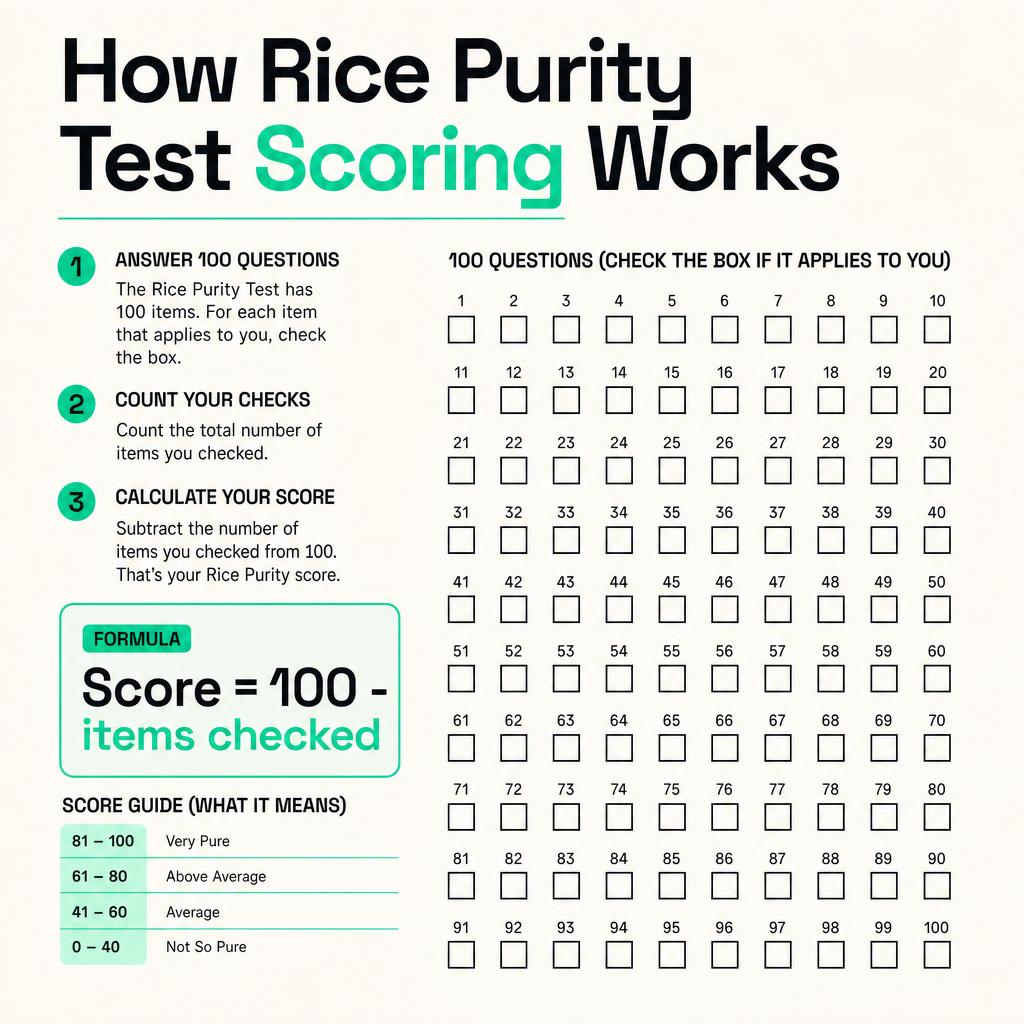
The scoring formula is one of the reasons the test caught on. There are no weighted questions, no multiple choice answers, and no algorithms running in the background. Each question is worth exactly one point, and every point you keep stays on your score. The full formula reads:
Your Score = 100 - (number of items you check)
That simplicity is also why the test is easy to compare with friends. Two people with the same score have checked the same total number of items even if the specific items differ. It also means the test is impossible to fail. There is no minimum score that gets you in trouble and no maximum that earns you a prize. The number is just a starting point for a conversation.
On this site the score updates in real time at the top of the page as you tick boxes. You can also see a per category breakdown so you know which sections of life have shaped your score the most. If you change your mind about a question you can simply uncheck it and your score goes back up by one point.
What your score actually means
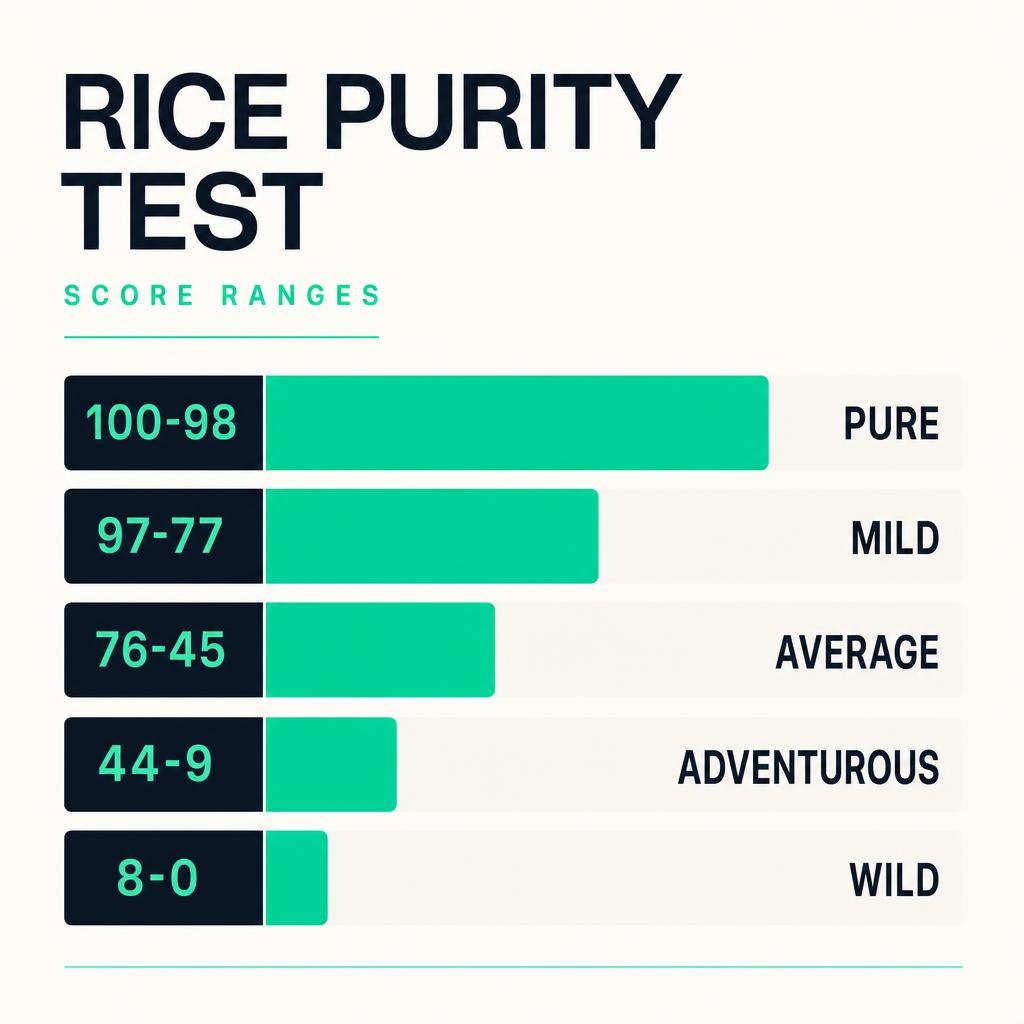
There is no official scoring rubric for the Rice Purity Test, but over the years a loose set of ranges has become the common way to read your number. These categories are descriptive, not judgmental, and they exist mostly so people can talk about results without getting into the specifics of which items they checked.
- 100 to 98: Very pure. You have not yet had most of the experiences on the list. This is common for younger high schoolers or for people who simply have not been exposed to the topics covered.
- 97 to 77: Mild. You have started to encounter some of the more common items, like dating or going to parties, but most of the heavier categories are still untouched.
- 76 to 45: Average. This is where most college aged users land. You have lived through a broad range of typical experiences but still have plenty of items you have not checked.
- 44 to 9: Adventurous. You have a wide range of experiences spanning most of the categories on the list, including some of the less common ones.
- 8 to 0: Wild. You have checked almost every item. This is rare, and people who land here tend to be older or to have lived through unusually eventful years.
It is worth saying again that none of these labels are official and none of them say anything about who you are as a person. They are a quick way to summarize a number, similar to saying someone is a beginner or advanced at a hobby.
How to take the test on this site
Our version of the test is built for speed, privacy, and a clean reading experience on phones and laptops. Here is what to expect when you take it.
- Start at the top. Scroll through the categories or use the filter pills to jump straight to a section. You can read the full list at once or page through twenty questions at a time.
- Tick the items that apply. Each box is large enough to tap comfortably on a phone. The sticky bar at the top shows how many you have checked and your live score.
- Use the search bar if you remember a specific question. The search runs as you type and filters the list in real time.
- Save your progress automatically. If you close the tab and come back later your checks are still there, stored on your own device. There is also a Reset button if you want to start over.
- Submit when you are ready. Tap Get My Score to see your final number, a per category breakdown, and a chart that compares your result to the typical distribution.
If you create a free account you can save each result you take and watch how your score changes over the years. Accounts are optional and the test works exactly the same way whether you sign in or not.
Why people take the Rice Purity Test
Different people take the test for very different reasons. For many high school and college students it is a friendly group activity. Friends take the test in the same room, compare scores, and share stories behind the items they checked. For others it is a private moment of reflection, a way to look back at the past few years and notice patterns they had not put into words before. Some people retake the test every birthday and watch the number drift downward as they live more of life.
There is also a curiosity factor. The list is broad enough that most people will read at least a few items and think, that has not happened to me yet, and a few more that bring up specific memories. The score itself is almost beside the point. What sticks with people is the reading of the list.
Score categories in more detail
To make the score ranges easier to read, here is a longer description of what each band tends to look like in practice. Keep in mind that two people in the same band can still have completely different stories behind their number.
The 100 to 98 range
People who land here often take the test very early, sometimes in middle school or the first year of high school. The list assumes a certain amount of social and personal exposure that simply has not happened yet. A score in this range is the most volatile, because a single year of normal life experiences can move the number significantly.
The 97 to 77 range
This is the range where the most common dating, party, and school related items begin to add up. A first relationship, a few late nights, the first time you stayed out past curfew, a minor brush with school discipline. These are the items that most teenagers collect through normal life without doing anything unusual.
The 76 to 45 range
If you are taking the test as a college student or a recent graduate, this is the most likely range to land in. The list at this point has caught up with your social life and a good slice of your travel, work, and relationship history. People here often describe their score as boring, which is funny because it is also where the average sits.
The 44 to 9 range
Scores in this range usually come from a combination of longer life experience and a willingness to check items that other people might be reluctant to mark. There is no single experience that drops you into this band. It is the sum of many smaller items adding up over years.
The 8 to 0 range
A score this low is uncommon. The test has 100 items on purpose so that almost no one ever checks all of them. Reaching single digits typically means many years of varied life experience and an honest read of the list. If you are far younger than that and your number is this low, it is worth being kind to yourself and remembering that the test is not a contest.
Common myths about the test
Because the Rice Purity Test has been around for so long, a few myths have grown around it. Here are the three that come up most often.
Myth one: a lower score is bad. The number is not graded. A score of 30 is not worse than a score of 90. The two scores just describe different amounts of life experience.
Myth two: the test predicts who you will become. Your score on a Tuesday afternoon says nothing about how you will live the next ten years. People with very pure scores go on to have eventful lives, and people with very wild scores often slow down and find quiet. The test is a snapshot, not a forecast.
Myth three: there is an official passing score. Rice University does not grade these tests. There is no admissions office reading them and no scholarship attached to a perfect 100. The score belongs to you and only you.
Tips for getting an accurate result
The test only works if you read the list honestly. Here are a few practical tips that make your final number more useful to you.
- Take it alone the first time. If you take the test with friends right out of the gate it is tempting to under check or over check items to match the group. The number you actually want is the one you would have written down if no one were watching.
- Read every question, even the long ones. Some items have specific phrasing that changes the meaning. Skim reading is the main reason people retake the test and get a very different score.
- Do not overthink edge cases. If you are not sure whether something counts, ask yourself if the spirit of the question fits your experience. If yes, check it. If no, leave it.
- Take it again in a year or two. The score is more interesting as a trend than as a single number. Saving each result gives you a small personal timeline.
Privacy and how we store your data
Your test runs entirely in your browser. The checks you make on the questions are kept on your own device so that you can leave the page and come back without losing your progress. We never see which items you checked.
If you create an account and choose to save a result, only the final score and the per category totals are stored. We do not store the list of individual items you checked. That means even if you save dozens of results to your profile, no one can rebuild your exact list of answers from our records. You can delete any saved result at any time from your profile, and you can delete your full account whenever you want.
You do not need an account to take the test. The link to your private result page on this site is generated locally and is not tracked.
Sharing your results without oversharing
Many people enjoy posting their score on social media. If you decide to share, here are a few things worth thinking about first.
- Your score does not need a caption. A single number says very little on its own. You do not owe anyone an explanation of which items you checked.
- Be careful with screenshots. If you take a screenshot of your final results, double check that nothing private is visible in the rest of the screen before you share.
- Think about who is watching. Family members, employers, and future partners can all see public posts. The Rice Purity Test is fun, but the internet has a long memory.
- Skip the comparison game. Other people are not lying when their scores look very different from yours. People simply lead different lives.
Frequently asked questions
How long does it take to finish?
Most people read through the full 100 questions in about ten to fifteen minutes. If you use the search bar to jump around or take the test in chunks, your progress is saved between visits, so there is no pressure to finish in one sitting.
Is the test accurate?
The test is accurate in the same way a checklist is accurate. It correctly counts the items you ticked. It does not measure your character, your value, or your future. It only summarizes a slice of your past.
What is a good score?
There is no good score. The number is descriptive, not evaluative. The most useful score is the one that reflects an honest reading of the list, whatever the final number happens to be.
Do my answers count toward anything?
No. The test is purely for self reflection and casual sharing. No school, employer, or service ever sees your individual answers.
Can I take the test more than once?
Yes, as many times as you like. Many people retake the test every birthday or every new school year to see how the number changes over time. If you have a saved account, each result is added to your profile history.
Why are some of the questions worded oddly?
The list keeps a lot of the original phrasing from earlier versions so that scores remain roughly comparable across generations. A few items have been updated when the original wording no longer made sense, but the core structure has stayed steady on purpose.
Final thoughts before you start
The Rice Purity Test has lasted for decades because it is simple, it is private, and it gives people a small reason to think about what they have lived through so far. Take the test in a quiet ten minutes, answer honestly, and read your number for what it is, a quick summary of a single moment in a long life. Whatever the number says, it is only one chapter, not the whole story.
When you are ready, scroll back to the top of this page and start checking. Your score will appear the moment you tap your first box, and a full breakdown will be waiting for you when you finish.