The Complete History of the Rice Purity Test
How a printed campus checklist at Rice University turned into the most copied online quiz of its kind, and what changed at every step.
The history of the Rice Purity Test starts on a university campus with a sheet of paper, not on the internet. The list of 100 statements was passed around students at Rice University in Houston, Texas, as an icebreaker during orientation. People read each line, ticked what applied to them, counted the unticked items, and compared numbers. That counting method is still the only rule the test has ever had.
This article traces the checklist from print to the web, explains why no two versions online match item for item, and shows what the current data on this site looks like. If you want the scoring rules and score bands first, read What Is the Rice Purity Test? and then come back.
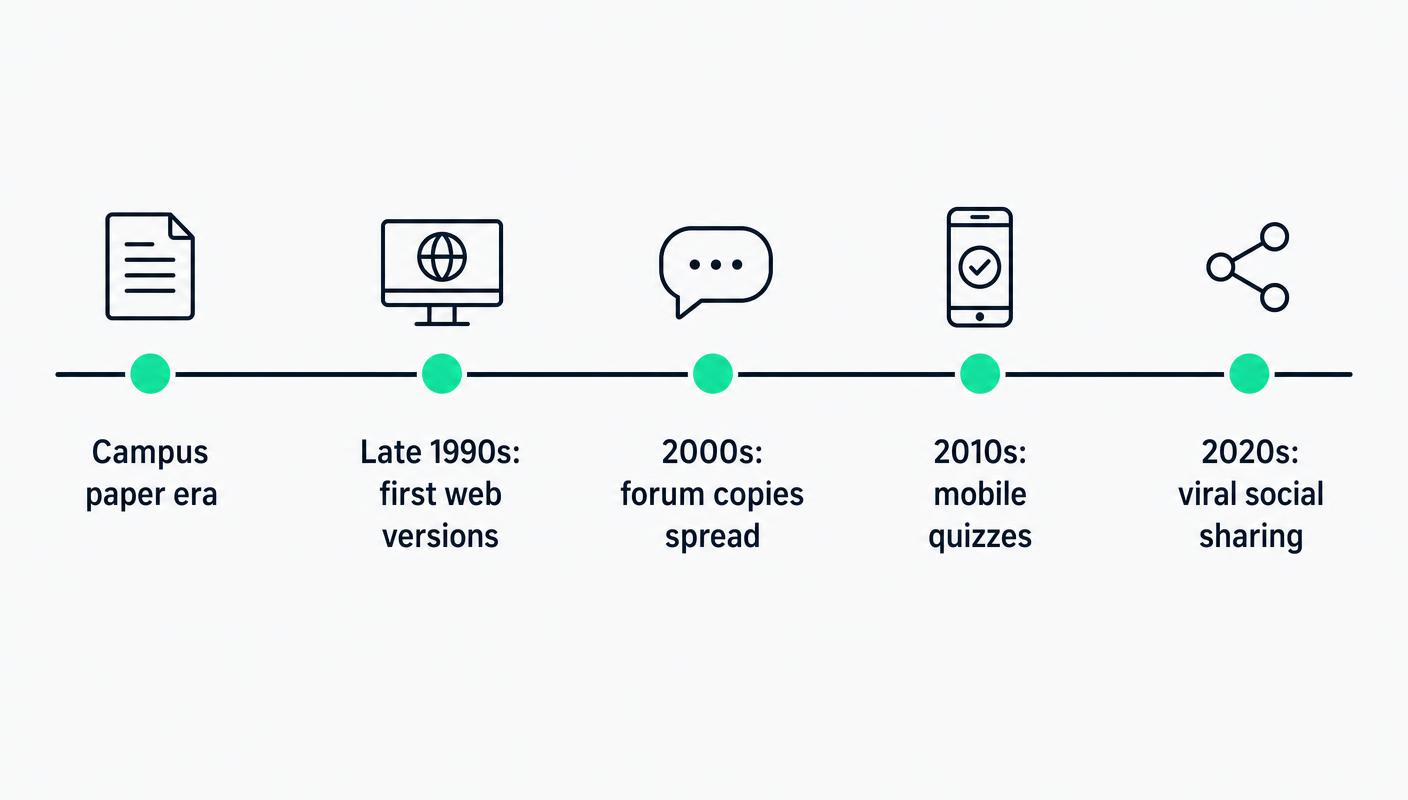
The five stages the checklist moved through.
The campus paper era
In its first form the test was a photocopied handout. It had two practical jobs at orientation: it gave new students something to talk about, and it broke the silence around subjects that are awkward to raise with strangers. Nobody collected the sheets and no score was recorded anywhere, so the number only existed for as long as the conversation lasted.
Two habits from that period survived every later version. The first is the fixed length of 100 items, which makes the score readable as a percentage without any maths. The second is the subtraction rule: you start at 100 and remove one point per ticked item, so a lower number means more items marked.
Late 1990s: the move to the web
As student pages and early websites became easy to publish, the handout was retyped into HTML. The web version added one thing the paper never had, which was instant counting. A checkbox form could total the ticks and print a score in a second, so the test stopped depending on someone sitting next to you to add up rows.
Those early pages are the reason the name spread beyond one campus. Search engines indexed them, students at other universities found them, and the checklist detached from Rice entirely. Rice University does not run, publish, or endorse any of the sites hosting the test today, including this one. The name records where the list began and nothing more.
2000s: copies, forums, and question drift
Through the 2000s the list travelled on message boards, blogs, and instant messenger chains. Each time someone reposted it, small edits crept in. Items that felt dated were dropped, local references were swapped for something more general, and new statements were written to fill the gaps back to 100.

Why two versions of the test rarely match line for line.
This is the single most useful fact about the history of the test. There is no authoritative master list. When two people compare scores taken on different sites, they are often answering different questions, which makes the comparison meaningless unless both used the same version. A score is only comparable against other scores from the same question set.
2010s: mobile and the quiz boom
The next shift was hardware. Once most traffic came from phones, the long single page form became painful to use, and versions appeared with one question per screen, progress indicators, and larger tap areas. The scoring did not change, but completion did. A checklist you can finish on a bus while waiting is finished far more often than one that needs a desktop.
This period also brought the score band language that people now use casually. Descriptions like high, mid, and low ranges were written by site owners, not by researchers, and they vary between sites in the same way the questions do.
2020s: social sharing
Short video platforms pushed the test into a much wider audience than campus ever did. Score reveals, group comparisons, and reaction clips travel well because the format needs no explanation: one number, ranked against everyone else in the room. That visibility is why the test is now taken by people far outside universities and far outside the United States.
What the data on this site shows
Because the history of the test is full of guesses about typical scores, here are the real figures recorded on dricepuritytest.com rather than a rumour. As of this update, 56 completed tests have been saved on the site. The average score is 64.9 and the median is 71. The lowest recorded score is 11 and the highest is 100.
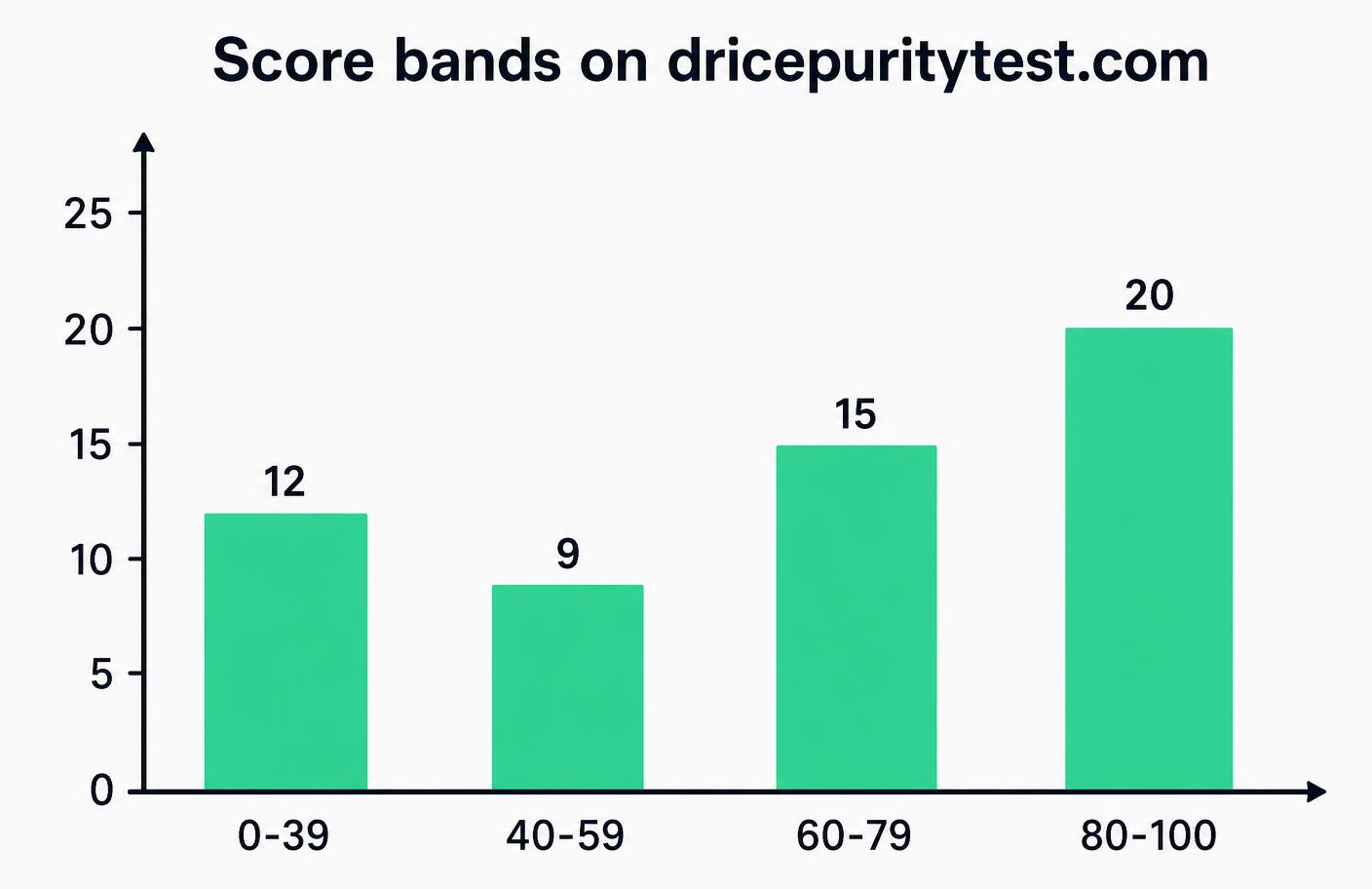
Score bands recorded on this site: 12 results in 0 to 39, 9 in 40 to 59, 15 in 60 to 79, and 20 in 80 to 100.
The median sitting above the average tells you the shape of the results. Most people land in the upper half, and a smaller group of low scores pulls the average down. This sample is small and comes only from visitors to this site, so treat it as a reference point rather than a population statistic. The numbers update as more tests are completed.
What our version does differently

Older copies of the test have three recurring problems: the question list is edited without notice, the result page carries no explanation, and the site keeps data it never needed. Our version handles each one directly.
One fixed question set. All 100 statements are the same for every visitor, so scores taken here can be compared with each other.
Scoring in your browser. The count runs on your device. You can take the test without an account and nothing is tied to your name.
Optional history. If you create an account, your scores are saved so you can see how a result changes over time. That is a choice, not a requirement.
Published numbers. The averages above come from actual completed tests on this site, not from an estimate.
You can start now on the Rice Purity Test page, or go back to the homepage for a short summary of how the score works.
What stayed the same and what changed
Across every version, three things held: the list is 100 items long, each unticked item is worth one point, and the result is a self report with no verification behind it. Nothing about the score is measured, graded, or checked against anything.
Four things changed. The delivery moved from paper to browser to phone. The wording of individual statements drifted with each repost. The audience widened from one campus to a global one. And the result page gained context, since a bare number told people nothing about what a 71 or a 34 actually described. Reading the history this way makes the limits of the test obvious. It is a conversation starter with a consistent counting rule, and it stops being useful the moment a number is treated as a verdict on a person.
Frequently asked questions
Who invented the Rice Purity Test?
No single author is documented. The checklist grew out of student culture at Rice University and was edited by many hands before it reached the web, which is why no version carries a credited writer.
When did the Rice Purity Test go online?
Web versions appeared in the late 1990s, once the paper handout was retyped as an HTML form that could count the ticks and print a score.
Does Rice University run the test?
No. The university does not operate or endorse the sites that host the test. The name refers to where the list started.
Why do different sites give me different scores?
Because the 100 statements are not identical across sites. Copies were edited repeatedly over two decades. Compare scores only when both were taken on the same version.
Has the scoring method ever changed?
The rule has stayed the same since the paper era: start at 100 and subtract one point for each item you mark. Any site using a different formula is scoring a different list.
Related reading
- How the rice purity score is calculated.
- What is the Rice Purity Test, a plain explainer.
- Take the test, or see the FAQ and the homepage.
Sources
- Rice University, founded in 1912 in Houston, Texas.
- The Rice Thresher, the campus newspaper published since 1916.
- Rice University overview, for founding dates and campus background.